
Case Study
KBS Jeju × 2026 Local Election
A public-broadcast AI reporting infrastructure combining AI analysis for 27 council districts, KBS Jeju news curation, an interactive election map, and newsroom operations.
27
Council Districts
43
Jeju EMD Boundaries
3
Workstreams
2026
KBS Coverage

AI district analysis broadcast graphic
District-level local issue analysis was turned into broadcast-ready AI content.
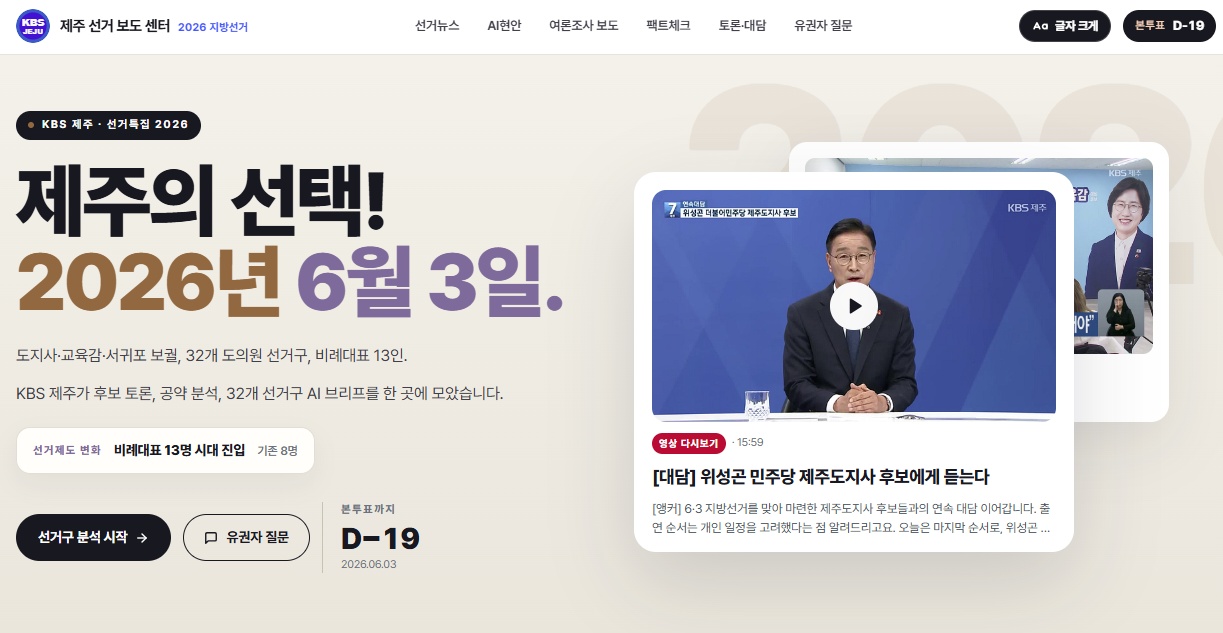
KBS Jeju public coverage
The AI-built interactive election news center was introduced in KBS Jeju coverage.
Analysis Pipeline
Data and Reporting Materials
KBS reporting materials, public statistics, local news, and district mappings normalized by council district
AI District Analysis
District profiles, issue discovery, deep-dive reports, and summary reports generated as structured outputs
Fact-Checking
A/B source grading, Claim Ledger, reference years, comparison periods, and neutral-tone validation
Broadcast Script
2 minute 30 second AI broadcast scripts and broadcast-graphic narrative structure
Interactive News Center
KBS Jeju news API collection, election-keyword classification, and map-based article exploration
Operations Console
Article hiding and restoration, manual classification, visit analytics, and voter-question moderation workflows
Project Overview
The KBS Jeju 2026 Local Election AI News Center combines district-level AI issue analysis with an interactive election reporting website built for public broadcasting.
STAI x BWLB developed the analysis workflow for 27 Jeju council districts, the broadcast script production flow, KBS Jeju news collection and classification, district-map exploration, and newsroom operations tooling.
The project was publicly covered by KBS Jeju in A challenge for local voters: the AI-built KBS Jeju Election News Center.
The Challenge
Fragmented Local Election Information
Local election coverage spans candidates, districts, local issues, articles, video, polling, interviews, and debate content. A plain list of articles was not enough for voters trying to understand what matters in their own district.
Public Broadcasting Standards
KBS election coverage requires political neutrality and factual accuracy. AI-generated analysis and scripts needed clear sources, reference years, comparison periods, and neutral language throughout the workflow.
A Website That Could Be Operated
The brief was not just to make a campaign-style landing page. The system needed to collect KBS Jeju articles, classify election-related coverage, and let editors hide, restore, and manually classify items from an admin console.
The Solution
1. AI District Analysis
For 27 Jeju council districts, the workflow produced district profiles, issue research, deep-dive reports, summary reports, 2 minute 30 second AI broadcast scripts, and fact-checking artifacts.
The analysis was built around local issues, not race-style prediction. Public statistics, reporting materials, local news, and policy documents were reviewed together. Key claims were paired with sources and reference dates using a Claim Ledger approach.
2. Interactive Election News Center
The public site was built with React, Vite, and Express. It collects articles from the KBS Jeju news API and classifies them using election-context signals such as local election, council district, candidate, pledge, polling, and debate keywords.
Using GeoJSON boundaries for 43 Jeju eup, myeon, and dong areas, the site maps them into 27 council districts. Selecting a district opens an AI brief, top local issues, and matched KBS Jeju coverage.
3. Newsroom Operations
The admin interface supports article hiding and restoration, manual classification, access statistics, and voter-question moderation workflows. Public views are driven only by approved or classified data so the site can operate within public-broadcast election standards.
Outcome
This project does not position AI as a replacement for editorial judgment. It structures recurring research, classification, summarization, and verification work so editors can understand local context faster and connect it to a public-facing election service.
The KBS Jeju News Center brings AI district analysis, election news curation, debate and interview archives, fact-checking, polling coverage, and voter questions into one civic information experience.
About the Partnership
The core of a public-broadcast AI project is not flashy automation. It is editorial control, source accountability, and operational reliability. STAI x BWLB designed the AI analysis system and the public website as one reporting infrastructure that could function inside an actual newsroom workflow.
Interested in deploying a similar system for your coverage? Contact us to discuss.